

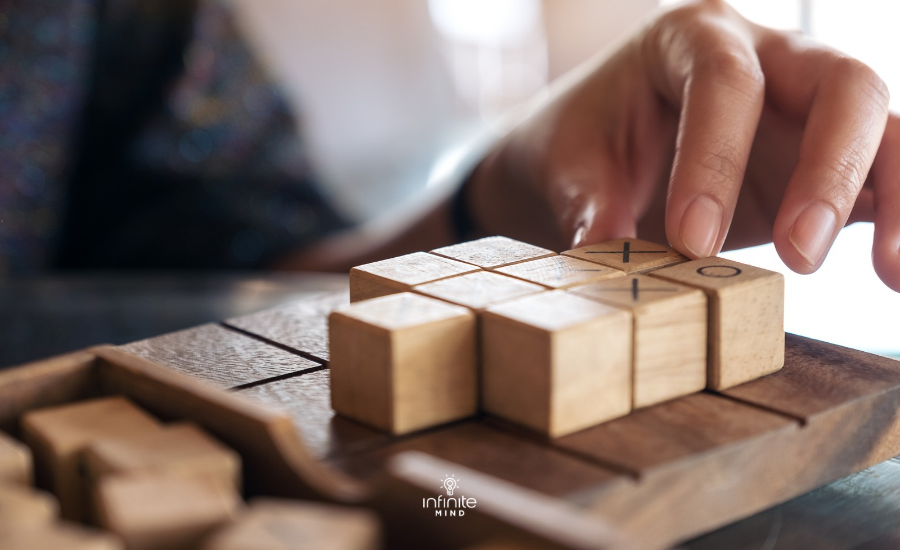
Spatial reasoning is the ability to picture objects, turn them in your mind, and see how parts fit together, and researchers have spent decades asking whether it can be trained. Think of packing a car trunk, reading a map, or following assembly diagrams. All of them lean on it.
This post walks through three bodies of research: a large review of training studies, a long-running line of work on spatial skills and STEM learning, and a university course that trained engineering students. It also covers what these studies cannot tell us.
What spatial reasoning looks like in everyday life
Psychologist Nora Newcombe of Temple University gives examples from science in her article in American Educator: Watson and Crick fitting a three-dimensional model to flat images of DNA, geoscientists visualizing how Earth processes unfold, and neurosurgeons reading MRI scans. Everyday versions are easier to spot, such as judging whether a couch fits through a door or rotating a map to match the street in front of you.
If you want definitions first, our posts on visual-spatial intelligence and spatial awareness cover them. This post focuses on the research question: what happens when people practice?
Curious how your own focus and reading skills respond to practice? Download Infinite Mind on the App Store and Google Play and try a session.
Can spatial reasoning be trained? A review of 217 studies
The largest answer so far comes from a meta-analysis led by David Uttal at Northwestern University, with Nora Newcombe, and published in Psychological Bulletin. As described in the Northwestern and Temple announcements, the team reviewed 217 studies of training and experience aimed at improving spatial skills.
According to the paper by the authors, 206 studies and 1,038 effect sizes remained after the team set aside a dozen outliers. The average effect of training compared with a control group was 0.47 on a standard scale, which the authors describe as "moderately malleable." Gains also showed up on tasks different from the one practiced, with an average transfer effect of 0.48. In the authors' words, several different forms of training can be highly successful. Examples in the announcements include using three-dimensional representations in physics classes and playing video games.
The authors were also upfront about limits. Published studies showed larger effects than unpublished ones, control groups often improved too, sometimes just from taking a test twice, and very few studies tracked people for more than a few weeks. Immediate and delayed tests showed no significant difference, but only four studies had delays longer than a month. Direct tests of how spatial training affects performance in a STEM subject were rare.
Spatial skills and later learning: what long-term studies suggest
Newcombe's article summarizes a wider body of work. In Project Talent, a study of about 400,000 people, those with high spatial scores in high school were more likely to major in and work in STEM fields, even after accounting for their verbal and math scores. She also describes longitudinal studies that tracked students from middle school into their careers, and work linking early block play to later math achievement.
These are associations. People who are strong at spatial tasks may also differ in other ways, so these studies do not show that building spatial skills causes later success. They do explain why researchers wanted to test whether the skills can be trained.
Training in a real course: the Michigan Tech engineering study
One of the clearest classroom examples comes from Michigan Technological University. In a conference paper for the American Society for Engineering Education, Norma Veurink and Sheryl Sorby analyzed a spatial visualization course that has been offered since 1993 to incoming students who scored 60 percent or lower on a standard mental rotation test (the Purdue Spatial Visualization Test: Rotations).
Among students who took the optional course in the 1996 to 2002 cohorts, the group that took it (234 students) finished with an average GPA of 3.01, compared with 2.63 for students who also scored low but did not take it (305 students). Retention at the university was 77.4 percent for the course group and 63.3 percent for the comparison group. The course group's retention was close to that of students who had passed the test at the start (73.6 percent), and that difference was not statistically significant.
The authors point out the main caveat: students chose the optional course themselves, so they may have been more motivated to begin with. When the course became required in 2009, the picture was mixed. Overall GPA was higher for the course group (2.83 versus 2.64 for students who barely passed the test), but the retention gap (90.4 percent versus 86.0 percent) was not statistically significant.
What kinds of practice did these studies use?
Newcombe's article describes several examples. Undergraduates who practiced mental rotation or paper folding daily for three weeks improved on new test items and on tasks they had not practiced. In another study, students who practiced mental rotation across a semester and played Tetris weekly showed training effects that she describes as very large and lasting several months, with carryover to other spatial tasks.
She also notes that people who start with low spatial skills may see a plateau during roughly the first half-dozen sessions before improving faster, that anxiety about spatial tasks can hurt performance, and that researchers do not yet know which teaching methods work best.
What this research can and cannot tell us
Taken together, these studies point in a consistent direction: spatial skills respond to practice, and the gains can carry over to related tasks. They also have limits.
Many of the studies were short. Several of the strongest results come from students at a single university, and some comparisons rely on people who chose to take part. The review itself notes that evidence on long-term effects and on real STEM performance is thin. None of the studies tested Infinite Mind. A better score on a spatial test does not guarantee a change in how someone does at work, in school, or in daily life.
Ways to practice spatial skills in daily life
These are drawn from the activities the research describes. They are suggestions to try:
- Try puzzles and building tasks. Newcombe recommends block play, puzzles, and model building as ways to exercise spatial thinking.
- Sketch what you see. Drawing an object from a different angle asks you to rotate it in your mind.
- Use maps, not only turn-by-turn directions. Reading a map asks you to relate a flat picture to real space.
- Give mental rotation or Tetris-style games a try. The training studies above used these kinds of tasks. Start with short sessions, since early progress can feel slow.
Where this fits with Infinite Mind
Practicing individual skills like mental rotation is a legitimate approach, and the research above supports it. Infinite Mind takes a whole-brain approach. It trains reading, eye movement, focus, and memory together, and checks progress against a real skill: reading speed and comprehension.
In a BYU study of 37 students who completed 12 sessions over six weeks, average reading speed rose from 298 to 949 words per minute and comprehension rose from 47 to 82 percent. You can read the details in Can You Really Read Faster? What Research Actually Found. That study reported reading speed and comprehension, so we do not claim that Infinite Mind changes spatial skills.
For the difference between games and training, read What Is the Difference Between Brain Games and Brain Training?. You can find more about the research behind the exercises on Our Science page.
Frequently Asked Questions
What is spatial reasoning?
Spatial reasoning is the ability to picture objects, rotate them in your mind, and understand how parts relate to each other. It is used in tasks like reading maps, packing, and following diagrams.
Can spatial reasoning be improved with practice?
A review of 217 training studies found that spatial skills responded to training, with an average moderate effect and some carryover to other tasks. The authors note that few studies followed people for long.
How long does spatial training take to work?
It varies. The studies described here ranged from a few weeks of daily practice to a semester-long course. Newcombe notes that people with lower starting skills may see an early plateau before improving.
Does Infinite Mind train spatial reasoning?
Infinite Mind trains reading, eye movement, focus, and memory together and checks progress against reading speed and comprehension. We have not tested spatial reasoning as a separate skill, so we do not make claims about it.
Ready to put your skills to work? Download Infinite Mind on the App Store and Google Play and start your first session today.