

Being mentally sharp isn’t a matter of luck or inherited traits—it’s about providing your brain with the necessary and proper support that will make it strong, flexible, and self-assured, no matter what age. Working with tens of thousands of adults ranging from their 20s to 90s, we have experienced something that is both comforting and motivating: the brain is much more resistant than most people think. By following the right practices, it keeps on forming new connections, getting over stress, and being very much involved with the surroundings.
For years, at Infinite Mind , we have been investigating the effects of training, lifestyle, and daily cognitive difficulties on the aging brain. What we have discovered is quite positive. Mental decline is not a fate that can be avoided. Most of the time, it is the consequence of habits that can be altered by applying the correct instruments and some regularity. When you get how your brain functions — and what it reacts to the most — you can have access to the purity, attention, and memory that are truly revitalizing.
This guide is intended to assist you in achieving that goal. It is not a collection of worn-out advice or common “brain hacks.” Rather, ten techniques will be introduced, which have already gained recognition through prolonged research, combined with actual client benefits, along with three vital components your brain needs to be sharp and efficient for the duration of your life. These principles have been applied by us to over two million students to enhance mental endurance and regain a feeling of cognitive assurance.
Quick Answers
How to Keep Your Brain Healthy
Concentrate on little daily practices that gradually strengthen the mind’s clarity and resilience. Our research has shown that regular physical activity, mental challenges, stress management, good sleep, and healthy eating are the main contributors to it.
Top Takeaways
- Cognitive decline is not a fate that can be altered. Your brain has the capacity to grow, adapt, and reinforce itself no matter the age.
- Daily little habits accumulate, forming slow but steady and very significant improvement in the long run.
- Some well-established methods, among others, lead repeatedly to very high results in cognitive areas: clarity, focus, and memory.
- What is more important is to be consistent rather than perfect; gentle repetition is the process that establishes change over time.
- If you get the right inputs and support, you will be able to stay mentally sharp, confident, and capable for the entirety of your life.
Imagine finally reading those books on your shelf, mastering new skills, and feeling confident in every conversation. It starts with better focus. Download Infinite Mind and take the first step today.
Prioritize Regular Movement
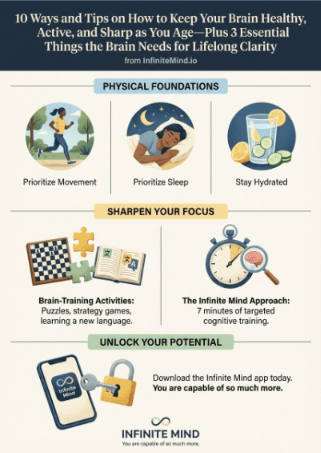
Your brain thrives when your body moves. Gentle cardio supports healthy circulation, giving your brain the oxygen and nutrients it needs to stay clear and energized. Strength training helps build the kind of physical stability that supports focus, and practices like yoga blend movement with mindful attention, lowering stress while sharpening mental clarity. You don’t need long workouts to make progress — a few minutes of intentional movement each day can create meaningful improvements over time.
Mind Your Nutrition
One of the major ways through which you affect your mental health is by the food you eat. Eating habits that have nutrient-rich foods at their center, such as blueberries, nuts, and leafy greens, basically assist in boosting memory, concentration, and providing prolonged energy. Just having a few go-to choices can help make healthy eating feel easy instead of daunting. When your diet is brain-friendly, all the mental processes, decision-making, and long-term learning included, become less demanding.
Practice Stress-management Techniques
Stress that lasts for a long time reduces one’s ability to think and wears out one’s cognitive stamina. Mindfulness methods—like paying attention to one’s breathing or softly connecting oneself to one’s surroundings—are effective in reducing mental noise and providing clarity. Movement-based practices such as yoga or tai chi integrate concentration and fluidity, thereby training one to remain calm even in tough situations. Just a few minutes of deliberate tranquility can change the whole day.
Limit Alcohol Consumption and Avoid Tobacco
Your brain depends on healthy cells and steady blood flow to function well. Excessive alcohol can interfere with cognitive processing and memory, and tobacco restricts circulation, increasing the risk of serious neurological issues. Being mindful of these habits protects your long-term clarity and supports your ability to regenerate and stay strong.
Incorporate Brain-training Activities
Targeted cognitive challenges like those on the Infinite Mind app are powerful tools for keeping your mind agile. Strategy games, memory exercises, and creative tasks like drawing or writing each strengthen different cognitive systems. Even learning a new language stimulates multiple regions at once. What matters most is choosing activities you enjoy so training feels engaging rather than like a chore.
Maintain a Positive Outlook and Mindset
Your mindset influences both your emotional well-being and your cognitive strength. Practices like affirmations, gratitude, and thoughtful reflection help reinforce resilience, improve mood, and support clearer thinking. A hopeful, grounded perspective doesn’t ignore challenges — it simply gives you the mental footing to move through them with confidence.
Stay Hydrated
Hydration directly affects how you think and feel. When you drink enough water throughout the day, it processes information more efficiently, your memory works more smoothly, and your overall energy stays more stable. Even slight dehydration can make tasks feel harder than they are. A steady intake of water helps you stay sharp, present, and mentally balanced.
Essential Nutrients and Supplements
Some nutrients play an especially important role in long-term brain health. Omega-3 fatty acids, found in foods like salmon, support memory and cognitive flexibility. Antioxidants help protect it from everyday stressors that can affect thinking over time. Certain supplements, such as ginkgo biloba, may support focus for some individuals, though results vary. It’s always wise to consult a healthcare professional before adding supplements to your routine.
The Role of Mindfulness and Meditation
Mindfulness isn’t only about relaxation — it’s a proven way to support cognitive clarity and emotional well-being. Simple practices like focused breathing, visualization, or brief meditations can help quiet mental clutter and increase your ability to concentrate. Even a few minutes each day can create a noticeable shift in how clearly and calmly your mind functions.
“Over the years and throughout all the cognitive training of thousands of adults, we have recorded the same very hopeful fact: the brain is still capable of development. It just lacks the proper care. Amazing things take place when you provide it with the correct inputs and stay with it through consistent practice. The people in their fifties, sixties, and even eighties who were once resigned to the states of mind described as limited have started regaining the abilities of clarity, focus, and mental stamina.”
Ready to unlock your infinite mind? Just 7 minutes a day can transform how you learn, focus, and succeed. Download the Infinite Mind app and discover what you’re truly capable of.
Essential Resources for Strengthening Your Brain and Supporting Lifelong Learning
National Institute on Aging: Brain Health — a clear foundation for understanding how your brain changes over time
URL: https://www.nia.nih.gov/health/brain-health
If you’re just beginning your journey toward better brain health, this is an excellent starting point. The NIA breaks down how the brain ages in simple, approachable terms and explains the key lifestyle factors that influence your cognitive well-being. You’ll come away with a grounded, science-informed understanding that prepares you to make confident choices.
NIA: Cognitive Health and Older Adults — practical strategies you can start applying today
URL: https://www.nia.nih.gov/health/brain-health/cognitive-health-and-older-adults
This resource gently guides you through the habits that support clear thinking—everything from managing stress to staying socially engaged. It’s especially helpful if you want to understand why certain habits improve focus and memory, not just what to do. You’ll find encouragement, clarity, and steps you can put into practice right away.
Alzheimer’s Association: 10 Healthy Habits for Your Brain — simple, everyday actions that strengthen cognitive resilience
URL: https://www.alz.org/help-support/brain_health/10-healthy-habits-for-your-brain
Improving brain health raises the question for many, where to start, and the Alzheimer’s Association has a great, accessible guide to the problem. With a habit of ten daily activities, some people find the whole thing not so hard, and more than one way to look at it is giving new life to the idea of using little changes—regular sleep, exercise, and brain games—literally to turn the time of change into a significant one.
Harvard Health: 12 Ways to Keep Your Brain Young — expert guidance grounded in real-world results
URL: https://www.health.harvard.edu/mind-and-mood/12-ways-to-keep-your-brain-young
Harvard’s approach blends research with everyday practicality, showing you how to maintain cognitive sharpness in ways that fit into your real life. Their recommendations help you connect brain health with long-term success, whether that means staying sharp at work, learning new skills, or simply feeling more mentally present and confident.
CDC: Physical Activity Boosts Brain Health — how movement unlocks energy, clarity, and emotional balance
URL: https://www.cdc.gov/physical-activity/features/boost-brain-health.html
Movement is one of the most powerful tools you have for supporting your brain, and this CDC guide explains the connection in a friendly, motivating way. You’ll learn how even modest daily activity can lift your mood, strengthen memory, and build long-term cognitive resilience—giving you another reason to get moving.
CDC: Healthy Diet, Healthy Brain — nutrition choices that help your mind stay clear and focused
URL: https://www.cdc.gov/healthy-aging/media/pdfs/2024/06/healthy-diet-healthy-brain-factsheet-508.pdf
Your diet seriously influences your mental and emotional states, and this resource assists you in recognizing that bond easily. The advice given here revolves around uncomplicated, eco-friendly dietary habits that improve memory, concentration, and eventually brain protection. Thus, the process of healthy eating becomes pleasant and rewarding.
Supporting Insights for Lifelong Health
Public health research gives us a double message, that is, it is both reassuring and empowering: you can control many factors that affect cognitive decline. The CDC predicts that a maximum of 45 percent of dementia cases can be prevented or postponed, which means that daily habits are strong determinants of long-term health. People get this message, and they feel the power again because daily decisions really count.
Source: cdc.gov
Nutrition is also a decisive factor as it has a high impact. Research on the MIND diet has revealed that individuals who rigorously adhere to it can reduce their chances of developing Alzheimer’s disease by a whopping 53 percent, whereas even a moderate commitment to it brings about a 35 percent decline in risk. Through our interactions with adults across the age spectrum, we can validate this aspect of real-life scenarios: the moment a person starts consuming food options that are beneficial for their brain, they often notice the change in their mental sharpness and vigor long before it is reflected in the statistics.
Source: caregiver.org
We also know that these benefits are not only reflected in people’s feelings but also in the brain. A study backed by the National Institute on Aging reported fewer Alzheimer-related changes in people who adhered to the MIND or Mediterranean diets. This is to say that lifestyle is not a mere superficial suggestion; rather, it leads to quantifiable physical distinctions in the brain.
Source: nia.nih.gov

Final Thoughts
After decades of working closely with adults at every stage of life, one truth has remained constant: your brain is always changing, and your daily choices shape that change far more than genetics ever will. Age brings shifts, of course, but the people who stay mentally sharp aren’t simply “lucky.” They treat their brain as something worth caring for every single day. They build habits that nourish clarity, strengthen focus, and keep their minds engaged long before problems appear.
What our experience shows
Across thousands of cognitive training sessions, we’ve watched the same encouraging pattern unfold. The brain responds beautifully to steady, meaningful stimulation. Small habits — practiced with intention rather than perfection — accumulate into long-term clarity. And what many people think of as “inevitable decline” often comes from long stretches without consistent engagement, not from aging itself. Lifelong sharpness isn’t created by quick fixes; it grows from an ecosystem of supportive practices that work together over time.
The bottom line
Cognitive decline doesn’t simply arrive one day. It builds slowly through neglected inputs and routines that never challenge the mind. The hopeful news is that the opposite is also true: lifelong clarity is something you can cultivate. It’s a lifestyle you build one choice at a time, and you can begin shaping it today.
FAQ: How to Keep Your Brain Healthy
Q: What daily habits support brain health?
A: Your consistency is the strongest point of your strategy. Daily physical activity is helpful for the body, and it keeps the blood flowing properly. A diet of high-quality foods that satisfy our energy needs for a long time. Mentally curious activities like reading, learning, or even new skills are all good options. Put sleep and your relationships first. Such minor, consistent habits lead to great and lasting advantages for your brain.
Q: How does diet affect your brain?
A: The role of nutrition is so significant that at one end, it could provide you with mental clarity and at the other, emotional stability. The rich sources of omega-3 fatty acids, the leaves of vegetables, fruits, nuts, and whole grains, all contribute positively to the health of the brain neurons. Lowering the intake of processed food not only lowers but also prevents inflammation, which can hurt memory and concentration. The majority of people, even those whom we have guided, experience clearer and more stable thinking right after changing their eating habits to ones that support the brain.
Q: Why does exercise boost mental clarity?
A: Motion facilitates the delivery of blood and oxygen to the brain, leading to instant enhancement in concentration, happiness, and mental acuity. Gradually, daily workouts become the means of reinforcing synapse connections and making the brain’s ability to withstand cognitive challenges longer. You can rely on even the most modest training sessions to provide you with such great benefits.
Q: Do learning and mental challenges really help?
A: Absolutely. The brain remains pliable and flexible to an extent when it is tuned in to the newly introduced and difficult things. Activities that require mental effort not only form but also strengthen memory, problem-solving, and cognitive flexibility through the development of new neural pathways. The most important aspect is to pick the activities that you really like—reading, puzzles, strategy games, or learning a new skill, to name a few—wherever that might be.
Q: Why is sleep essential for brain health?
A: Sleep is the period when the brain rejuvenates itself. During the deep sleep phase, metabolic waste gets cleared, cell repair takes place, and memory consolidation occurs in the brain. If the quality and quantity of sleep are insufficient, then the brain will slow down its thinking, make less memory, and increase the levels of stress. Thus, protecting your sleep routine may be among the best decisions you could ever make for maintaining cognitive health throughout your lifetime.