

Visual Spatial Intelligence (VSI) – This Crucial Cognitive Skill That Shapes How You See and Navigate the World
If you’ve ever watched someone effortlessly picture a shape from a different angle, find their way through a new city without hesitation, or instantly grasp the layout of a room, you’ve seen visual-spatial intelligence at work. It’s one of the brain’s quiet powerhouses—an ability that helps you interpret the world, make sense of complex information, and move through life with greater confidence.
Infinite Mind has been researching the brain’s processing of visual and spatial information in people of different ages. We have collaborated with athletes who depend on quick spatial judgment; with children who are developing basic cognitive skills; and with seniors who want to keep their minds active. The collective experience of research has led us to the remarkable conclusion that visual-spatial intelligence is not just an auxiliary skill, but rather the main factor that influences reading, comprehension, problem-solving, creativity, and overall confidence in everyday situations.
Usually, when individuals build this skill, they report being more powerful at their jobs, quicker in learning, and more stable in their movements through the world around them. The reason is that this skill is based on neuroplasticity, and thus, your brain can constantly enhance it no matter your age, provided that you undergo the appropriate kind of training.
Quick Answers
What is Spatial Intelligence?
Spatial intelligence is the brain’s ability to visualize, understand, and mentally manipulate objects and space. At Infinite Mind, we see it as the cognitive skill that helps you “see before you do”—whether you’re reading a map, judging distance, assembling something, or navigating a new environment.
Top 5 Takeaways
- Visual-spatial intelligence is the most basic cognitive skill that showcases the manner in which you perceive, interpret, and navigate through the world, thus influencing the whole process of comprehension and even decision-making.
- It performs an essential role in everyday capabilities of reading maps, assembling an apparatus, gauging distances, or understanding visual diagrams and instructions.
- Numerous professions count a lot on good spatial reasoning, like in the case of architecture, engineering, design, aviation, and surgery, where high accuracy and good spatial judgment are required.
- This power can be enhanced at any point in life by means of puzzles, drawing, model-building, playing strategy-based video games, and mind mapping, which all invigorate spatial processing.
- Based on our direct experiences with a large number of students, we can confidently say that visual-spatial intelligence enhancement directly impacts the learning process, i.e., it results in better grades and increased self-assurance in real-life situations.
Ready to unlock your infinite mind? Just 7 minutes a day can transform how you learn, focus, and succeed. Download the Infinite Mind app and discover what you’re truly capable of.
Understanding the Key Component of Multiple Intelligences
When most people think about intelligence, they picture solving equations or writing essays. But visual-spatial intelligence is just as essential—and often just as transformative. This ability helps you form mental maps, understand how objects relate to one another, and picture movement or structure in your mind.
It’s the quiet skill that lets you imagine how a piece of furniture will fit in a room or navigate a new environment with confidence. In many ways, it works like your brain’s internal GPS, guiding how you interpret and move through the world.
Visual Spatial Role in Everyday Activities
Visual-spatial intelligence supports countless daily tasks that we often take for granted. It strengthens your awareness of your surroundings and helps you understand how pieces come together in space.
Whether you’re weaving through a crowded room, packing a suitcase efficiently, or organizing a closet, this skill is doing quiet, steady work in the background. It also shapes practical abilities like driving, reading maps, assembling objects, following diagrams, and even coordinating your movements during sports. When this cognitive skill grows stronger, everyday life feels a little easier, a little more intuitive.
Professions that Benefit from Enhanced Visual Spatial Intelligence
Many careers rely heavily on visual-spatial strength, and individuals who cultivate it often find they excel in roles that require big-picture thinking and precise detail.
- Architects use spatial reasoning to design structures that are both functional and beautiful. Engineers rely on it to develop machinery, systems, and solutions that must work flawlessly in three-dimensional space.
- Designers and artists draw on visual-spatial intelligence to create compelling visuals that resonate with audiences.
- Video-game designers imagine and construct immersive digital worlds that feel natural to navigate.
- Interior decorators use it to balance color, space, and flow.
- Urban planners visualize entire communities before they’re built.
- Pilots depend on strong spatial judgment for safe navigation.
- Surgeons use exceptionally refined spatial skills to work with precision.
Across these fields, spatial intelligence becomes a professional advantage—one that supports accuracy, creativity, and consistent high performance.
How to Develop and Enhance VSI
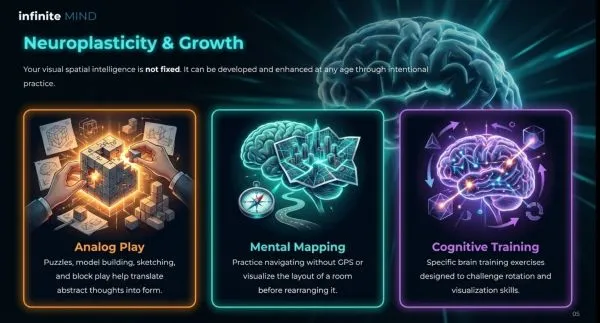
Strengthening visual-spatial intelligence is both accessible and surprisingly enjoyable. Because the brain is adaptable, activities that challenge your ability to visualize, rotate, or organize information stimulate the neural pathways that support spatial reasoning.
- Mind mapping helps you view your thoughts in a more structured, visual way.
- Puzzles require you to imagine how pieces fit together.
- Sketching sharpens your ability to translate what you see into meaningful form.
- Model-building lets you work hands-on with structure and design.
- Even certain video games strengthen spatial planning and mental rotation.
These practices in concert with consistently engaging the Infinite Mind app are not only effective—they’re engaging, creative, and available to learners of any age.
Real-world Applications and Examples
Visual spatial intelligence isn’t just fascinating in theory; it’s incredibly practical in the real world. Professionals in architecture, engineering, and urban planning rely on it to picture buildings, roadways, and entire communities long before they exist. Artists and designers use it to create visuals that make an impact. Product developers apply visual thinking to imagine new solutions and prototype ideas. Video-game creators design worlds that feel intuitive to explore. And in daily life, this skill shows up in simple, meaningful ways—from assembling furniture to reading maps to rearranging a room so it feels just right.
“We have observed the rise of a similar beneficial trend in the course of our practical experience with athletes, students, and professionals. The advancements in visual-spatial intelligence not only facilitate faster problem-solving but also lead to better awareness in decision-making and more trustworthy instinctual feelings.”
You’re capable of so much more. Start unlocking your learning potential today—get the Infinite Mind app and see what happens when you sharpen your focus and accelerate your growth.
Essential Resources for Understanding and Strengthening your Spatial Intelligence
- A friendly starting point for understanding spatial intelligence
At the beginning of your adventure with spatial intelligence, getting a straightforward and reliable explanation is very useful. The Encyclopaedia Britannica’s summary on the different kinds of intelligence provides you with a very simple foundation for grasping spatial intelligence and its importance. You will gain a strong and science-supported comprehension, which is ready for you to delve deeper into the subject with certainty.
URL: https://www.britannica.com/science/multiple-intelligences
- A deeper look at the science behind spatial ability
Once you understand the basics, you may want to see how researchers define and measure spatial skills. This ScienceDirect article breaks down spatial ability as a real, distinct part of human cognition. The language is academic, but the insight is empowering—you can clearly see how these skills shape everything from daily tasks to long-term learning.
URL: https://www.sciencedirect.com/science/article/pii/S0160289621001008
- An engaging explanation of how your brain understands space
If you’re curious about how the mind creates mental maps, pictures, and pathways, this Cognitive Science review is a wonderful next step. It explores how we navigate the world, remember spatial relationships, and visualize information. You’ll feel like someone just handed you a clearer picture of how your mind organizes space—and how you can strengthen that process.
URL: https://wires.onlinelibrary.wiley.com/doi/pdfdirect/10.1002/wcs.1198
- A research-backed guide to developing spatial skills early
Parents and educators often wonder how to support children as they learn to reason about the world around them. This resource from EDC helps you understand why early spatial thinking predicts later success in math and STEM. It offers simple, encouraging ways to help kids build these skills—reminding you that small moments of practice create lifelong confidence.
URL: https://www.edc.org/insights/fostering-spatial-thinking-in-young-children/
- A practical way to measure and track spatial skill growth
If you’re ready to evaluate your own spatial reasoning or help a student measure theirs, the Purdue Spatial Visualization Test is a reliable, hands-on tool. It focuses on how well you can mentally rotate and visualize objects—abilities you can absolutely improve with practice. Many learners find that seeing their progress quantified boosts both motivation and confidence.
URL: https://www.spatiallearning.org/tools/revised-purdue-spatial-visualization-test-revised-psvtr-visualization-of-rotations
- A clear connection between spatial skills and STEM success
Sometimes the most inspiring insights come from understanding the “why.” This piece from the MIND Research Institute shows how spatial thinking supports math learning and STEM performance. It’s grounded in decades of research, yet feels encouraging and accessible—you’ll see how strengthening spatial skills can open doors in school, work, and everyday problem-solving.
URL: https://2024.mindresearch.org/blog/importance-of-developing-spatial-skills
- Proven strategies you can start using right away
If you’re eager to improve your spatial intelligence, this Digital Promise guide offers five simple, research-backed strategies you can put into practice immediately. These methods feel doable even on busy days, and they help you build real momentum. Many learners are surprised by how quickly consistent practice leads to noticeable improvement.
URL: https://digitalpromise.org/2024/09/12/5-research-backed-strategies-to-help-learners-build-spatial-skills/
Supporting Statistics: Why Spatial Intelligence Matters
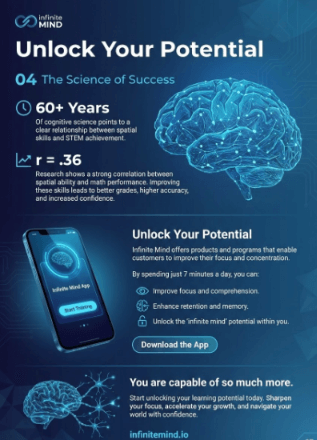
- More than sixty years of cognitive science point to a clear relationship between spatial skills and STEM achievement. Students who strengthen their spatial reasoning tend to learn STEM concepts more effectively, a trend that aligns with what many educators observe in real classrooms.
(Source: eric.ed.gov)
- Research also shows a strong connection between spatial ability and math performance, with studies reporting a correlation of r = .36. When learners build stronger spatial skills, their math accuracy and confidence frequently improve alongside them.
(Source: files.eric.ed.gov)
- National assessments highlight the need for better support in this area. Only six percent of American fifteen-year-olds reach advanced proficiency on spatially intensive math tasks, while twenty-nine percent fall below basic proficiency. Teachers often share similar experiences, noting that visual-math tasks tend to be especially challenging for students.
(Source: files.eric.ed.gov)

Final Thoughts
After working closely with thousands of learners—athletes refining split-second decision-making, students strengthening foundational skills, and adults wanting to feel sharper and more capable—we’ve seen how often visual-spatial intelligence is overlooked. Yet it quietly shapes so many moments in daily life. When this skill grows stronger, people tend to move through the world with more confidence, more clarity, and a renewed sense of capability.
What our experience shows
When learners begin strengthening their visual-spatial skills, the progress is often immediate and noticeable. Many describe suddenly “seeing” geometric or spatial concepts more clearly, navigating unfamiliar environments with less hesitation, or reacting faster in high-performance settings like sports or aviation. Even small improvements create meaningful ripple effects—better focus, smoother problem-solving, and more confident everyday decision-making.
Our unique perspective
Through years of hands-on cognitive training, we’ve come to understand visual-spatial intelligence as the brain’s quiet navigation system. It organizes spatial information, supports efficient problem-solving, and influences how at ease someone feels in physical environments. And because this system is adaptable, it can be strengthened at any age through intentional practice.
Our core belief
Visual-spatial intelligence is not fixed. It’s a trainable, flexible cognitive skill that becomes a powerful advantage when nurtured consistently.
The bottom line
When you strengthen this ability, the impact touches every part of life: children gain momentum in learning, professionals perform with greater precision, and individuals of all ages feel more grounded and confident in how they navigate the world. At InfiniteMind.io, we’ve witnessed these transformations firsthand—and we believe that investing in visual-spatial intelligence is one of the most meaningful ways to change how you think, learn, and move through your day.
FAQ on Spatial Intelligence
Q: What is spatial intelligence?
A: The capability to visualize and mentally handle things in one’s brain is what it is. This talent allows you to move around, draw maps, and see through a problem before taking action, and it is applied in daily life much more frequently than the vast majority of people even recognize.
Q: Why does spatial intelligence matter?
A: When you pack, plan a route, play sports, or arrange a room, you depend on it. If this ability is developed, these activities will purely be a matter of common sense rather than a source of irritation, and your general problem-solving will be quicker and more precise.
Q: Can spatial intelligence improve?
A: Absolutely—improvement is possible throughout one’s lifespan. The brain’s spatial-processing pathways are reinforced through various activities such as puzzles, strategy games, drawing, building models, playing certain video games, and discovering new places.
Q: Which careers rely on spatial intelligence?
A: Spatial skills are very much needed in areas like architecture, engineering, construction, interior design, surgery, dentistry, aviation, athletics, and any other profession dealing with visual planning or 3D reasoning.
Q: How can kids build spatial skills?
A: One of the strongest instruments is hands-on play. Building blocks, drawing, making kits, going to nature, and creative solving of problems are all activities that contribute to the development of spatial reasoning in children. Children learn most effectively through the direct experience of touching, testing, exploring, and creating.