

When you’ve ever paused in the middle of a decision and wondered, “Why do I keep reacting this way—and how do I finally shift it?” you’re already stepping into the world of intrapersonal intelligence. This kind of self-awareness isn’t abstract or philosophical. It’s a practical, deeply personal skill that shapes how confidently you move through your day. At Infinite Mind, we’ve spent years studying the patterns behind self-understanding, and we’ve seen how intrapersonal intelligence becomes the quiet engine behind real, lasting growth.
Self-awareness cannot be defined merely by the expression “knowing yourself.” It is the ability to perceive the internal signals—emotions, habits, impulses, and beliefs—that determine your actions. Seeing the patterns clearly, you will be able to change them according to your wish. Thousands of learners have gone through our research and practical work, and this has always led to the same conclusion: interpersonal intelligence is a major skill that allows people to shift from passive living to making purpose-driven and conscious decisions.
Pupils who develop this ability usually say they experience more stability, more power against difficulties, and a more positive view of the changes they want to make. It is a personal success cornerstone since it allows you to know what is happening inside you and gives you the clarity to respond rather than react.
Quick Answers
What Is Intrapersonal Intelligence?
Intrapersonal intelligence refers to the capacity of a person to comprehend his or her own thoughts, feelings, and motives and to apply that understanding for making improved decisions. We, at Infinite Mind, have noticed that individuals with well-developed intrapersonal intelligence:
- Rapidly identify emotional patterns
- Realize the reasons for their reactions
- Select intentionally rather than through forced choices
- Develop quickly because they know what their drives are
Top 5 Takeaways
- Through conversations across these areas, the parameters and motivations behind our everyday decisions sink in, helping us to find comfort in our own behavior or reactions and gradually initiate positive growth.
- Self-awareness is constructed through deliberate practice as opposed to guesswork and incrementally develops with continuous reflection.
- Many phenotypes cry over the term self-belief in the smart context today.
- Your internal conflicts will help you solve the more advanced problems, thus achieving better problem-solving, finally giving you a stronger sense of direction.
- Strengthening this intelligence consequently positively benefits one's emotional stature, calmness, and self-acceptance.
Imagine finally reading those books on your shelf, mastering new skills, and feeling confident in every conversation. It starts with better focus. Download Infinite Mind and take the first step today.
A Deep Dive Into Self-Awareness
Most people move through their days without ever stopping to fully understand what’s happening inside them. Intrapersonal intelligence changes that. It’s the skill that helps you slow down, notice your inner world, and make sense of the thoughts and feelings that drive your choices.
At Infinite Mind, we see self-awareness as a learnable, lifelong skill—one that grows through intentional practices like journaling, mindfulness, and simple moments of honest reflection. These habits create the space to observe your reactions, understand your emotions, and strengthen your ability to regulate them. Over time, this awareness becomes a steady foundation for focus, confidence, and personal growth.
Key Characteristics
Intrapersonal intelligence, the strongest of the multiple intelligences, mainly puts together self-awareness as a prerequisite. Such people are constantly in touch with their inner selves and keep communicating with them actively. They are deliberately going through their thoughts, feelings, and convictions, and at the same time getting clues about these through their reflections. This presence of mind usually empowers them to control their emotions better and, in particular, during difficult and uncertain times.
They are honest and noncritical in recognizing their strong and weak points, which leads them to create personal goals that are both plausible and uplifting. A characteristic of these people is usually the language of discipline and intentionality, traits that promote proper decision-making and consistent guidance. The essence of this intelligence, though, is knowing yourself so well that you can choose the paths that are genuinely in line with your present and future selves.
The Role of Intrapersonal Intelligence in Personal Development
Intrapersonal intelligence is the foundation of personal growth and development. By getting to know your inner self, you are able to see more clearly the path to purposeful growth. Through self-reflection, you become aware of the factors that speed up your progress and the ones that slow you down. This knowledge helps to build better choices, to practice more healthful ways of living, and to have a more balanced realization of oneself.
The ability to control one's emotions is also very important. If you could comprehend and handle your feelings, the stress would decrease, the bonds would become stronger, and the overall quality of life would be better. This is the reason why the students often refer to intrapersonal intelligence as the skill that makes one feel the growth process to be accessible and not overwhelming.
Here are ways intrapersonal intelligence enhances personal development:
- Self-assessment: It helps you identify the areas that need attention and set goals that feel both achievable and meaningful.
- Mindfulness: It teaches you to stay present, creating calm and awareness in moments that might otherwise feel rushed or reactive.
- Emotion management: It helps you recognize and manage emotions in a way that supports healthier communication and stronger relationships.
- Motivation: It clarifies what drives you, helping you stay committed to your aspirations with more confidence and purpose.
Real-Life Examples in Action
You can see intrapersonal intelligence at work in everyday situations. Mindful journaling, for example, gives people a private space to explore their thoughts, name their emotions, and notice recurring patterns. Someone writing about a disagreement with a friend might realize that the sadness they felt wasn’t about the argument itself, but the fear of damaging a valued relationship.
That kind of insight makes emotional regulation easier and strengthens the connection between intention and action. Moments of reflection like this—small but meaningful—build a clearer understanding of oneself. And as that understanding grows, so does the ability to make choices that support long-term growth and emotional well-being.
Strategies to Enhance Your Intrapersonal Intelligence Skills
Strengthening intrapersonal intelligence begins with self-understanding, and several proven practices make this growth accessible:
- Mindfulness practices: Meditation, focused breathing, or simple moments of quiet help you tune into your thoughts and emotions with more clarity.
- Reflective journaling: Writing regularly helps you process daily experiences, understand emotional reactions, and track your personal growth over time.
- Setting personal goals: Defining clear, realistic goals gives you direction and reveals the strengths and habits that support your progress.
- Seeking feedback: Thoughtful input from trusted people can offer perspectives you might not see on your own, strengthening your understanding of patterns and behaviors.
Practiced consistently, these strategies help you build a richer, more accurate awareness of yourself—one that supports lifelong learning, healthier choices, and a deeper sense of confidence in your own growth.
“Having spent over ten years in the research of people’s thought processes, reflections, and their ways of growing, we can conclude that intrapersonal intelligence is a ‘soft skill’ no more. It is an internal, measurable framework that has a subtle influence on every decision you make. An important change occurs when you know the real reason for a certain behavior or when you see the pattern of an annoying habit. Your choices will be clearer, your self-assurance will be greater, and the path of your existence will start to look deliberate instead of automatic.”
Ready to unlock your infinite mind? Just 7 minutes a day can transform how you learn, focus, and succeed. Download the Infinite Mind app and discover what you're truly capable of.
Essential Resources for Understanding & Growing Your Intrapersonal Intelligence
Verywell Mind: A Clear, Encouraging Introduction to Intrapersonal Intelligence
This summarized version provides a solid basis for you without the risk of overwhelming you. It simplifies the idea into pleasant and easily comprehensible words so that you can instantly realize how intrapersonal intelligence appears in your everyday choices, feelings, and objectives.
URL: https://www.verywellmind.com/intrapersonal-intelligence-8610181
Howard Gardner’s Multiple Intelligences Framework (Harvard Project Zero): The Groundwork That Started It All
Gardner’s original research gives you a deeper understanding of where intrapersonal intelligence fits within human cognition. When you read it, you begin to see that your ability to understand yourself isn’t a mystery—it’s a skill you can develop with intention.
URL: https://pz.harvard.edu/sites/default/files/Theory%20of%20MI.pdf
TEM Journal Research Article: A Balanced, Evidence-Based Perspective
If you’re someone who feels more confident when you understand both the strengths and limitations of a theory, this peer-reviewed article will help you think through intrapersonal intelligence with a clear, informed lens. It gives you the kind of balanced view that leads to strong, confident decisions about your own learning.
URL: https://www.temjournal.com/content/143/TEMJournalAugust2025_2557_2569.pdf
Simply Psychology: An Easy-to-Understand Guide to the Entire MI Model
This resource helps you see intrapersonal intelligence in the context of all eight intelligences, making it easier to understand your personal strengths. Many learners find this perspective encouraging—it reinforces that intelligence is multi-dimensional, and you have more strengths than you’ve been taught to recognize.
URL: https://www.simplypsychology.org/multiple-intelligences.html
PositivePsychology.com Self-Awareness Tools: Research-Backed Methods You Can Trust
If you’re ready to strengthen your inner clarity, these evidence-based activities give you structured steps to follow. They’re grounded in psychology research, but written in a way that feels supportive, encouraging, and completely doable.
URL: https://positivepsychology.com/building-self-awareness-activities/
ASCD / Thomas Armstrong Teaching Strategies: Guidance for Growing Intrapersonal Skills in Real-Life Learning
Whether you’re a student, educator, parent, or lifelong learner, this resource shows you how intrapersonal intelligence can be nurtured over time. The strategies are simple, thoughtful, and designed to help anyone build stronger internal awareness and greater confidence in their ability to grow.
URL: https://files.ascd.org/pdfs/publications/books/scherer2010_sample7.pdf
Supporting Statistics
Research across education, psychology, and workplace performance consistently shows how deeply intrapersonal intelligence influences everyday life. These findings help illustrate why strengthening self-awareness and emotional regulation creates such meaningful, lasting change.
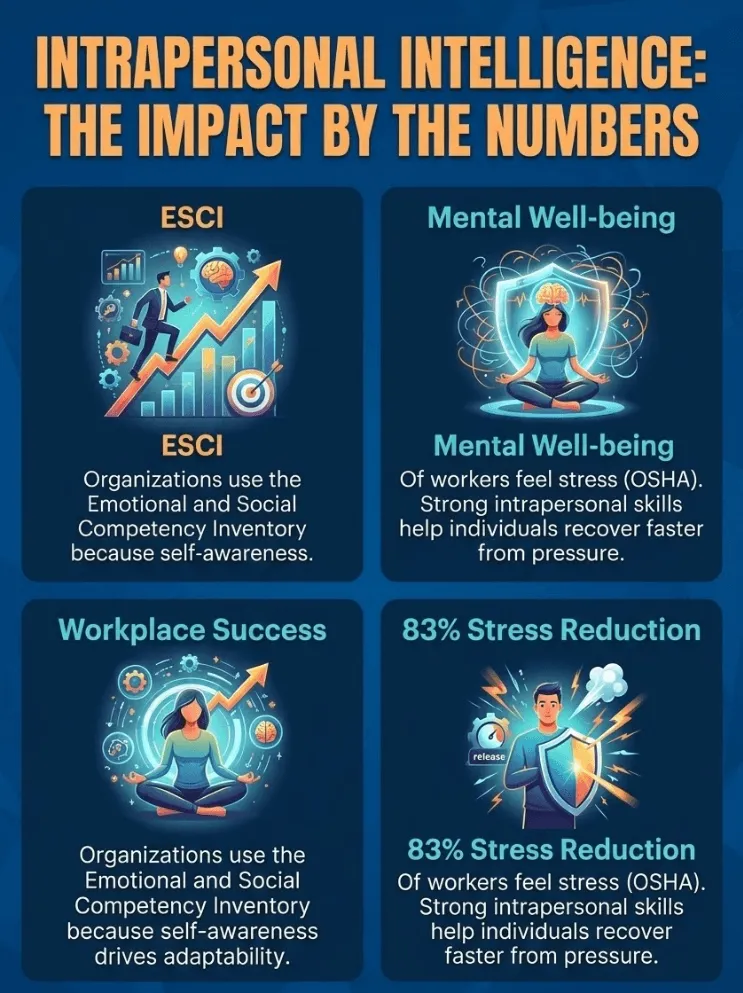
- Organizations actively measure intrapersonal skills
Across many industries, formal tools like the Emotional and Social Competency Inventory (ESCI) are used to evaluate self-awareness and self-management. This isn’t theoretical—companies rely on these assessments because people with stronger intrapersonal skills tend to adapt more quickly, communicate more clearly, and navigate change with greater confidence.
Source: frontiersin.org
- Emotional self-awareness supports mental well-being
According to the National Institutes of Health, one in five U.S. adults experienced a mental illness in 2020. Many of these challenges involve difficulty understanding or managing internal emotions. In our work, we see that when people begin to recognize their emotional patterns, their daily functioning, stability, and resilience improve in meaningful ways.
Source: nimh.nih.gov
- Intrapersonal skills reduce workplace stress
Workplace stress is widespread—OSHA reports that 83% of U.S. workers experience it. Individuals with strong emotional regulation skills recover more quickly from stressful moments and communicate with greater clarity under pressure. These abilities help create healthier work environments and more sustainable performance.
Source: osha.gov

Final Thoughts & Perspective
Across our years of hands-on research and learner support at InfiniteMind.io, one truth has become unmistakably clear: intrapersonal intelligence isn’t optional. It’s the internal engine that powers every other form of personal development. Even strong motivation and willpower fall short when they aren’t supported by self-awareness, emotional clarity, and an honest understanding of what’s happening inside you. When those pieces are missing, change rarely lasts. But when they’re present, transformation becomes not only possible—but sustainable.
What we’ve seen in real training environments is both simple and profound. The people who grow the fastest aren’t always the most disciplined. They’re the ones who pause long enough to notice what they feel, why they react, and how their inner world is influencing their choices. That moment of clarity—small as it may seem—creates a ripple effect. Confidence strengthens. Emotional regulation improves. Decisions become more grounded and intentional. From there, growth unfolds in a way that feels natural instead of forced.
What Our First-Hand Experience Shows
Across coaching sessions, cognitive training programs, and thousands of learner stories, intrapersonal intelligence consistently helps people shift their lives in meaningful ways. As this skill develops, individuals begin moving from reactive patterns to intentional choices. They start recognizing emotional cues before those feelings turn into unhelpful habits. They become more aware of the beliefs—both helpful and limiting—that drive their decisions. And as these insights deepen, their actions become more aligned with their goals and values.
FAQ on Intrapersonal Intelligence
Q: What is intrapersonal intelligence?
A: Self-awareness is your ability to recognize and understand your thoughts, feelings, and internal mechanisms. This understanding allows you to interpret your reactions and thus make decisions that are both grounded and intentional, feelings-wise.
Q: Why does intrapersonal intelligence matter?
A: It promotes emotional stability, lucidity, and toughness—particularly in times of stress or big changes. A lot of users refer to it as the “reset button,” helping them touch base when they feel that life is too much.
Q: How can I strengthen intrapersonal intelligence?
A: Beginning with straightforward, uniform habits that gradually create awareness is the way to go. Recording your daily thoughts in a journal could expose some trends that you might not notice otherwise. Mindfulness for a few minutes allows you to get back in touch with your feelings. Taking a moment before making important decisions helps you to clarify what you are really feeling. Noting down the things that cause your reactions or tracking your responses can bring out new understandings that will eventually lead to lasting change.
Q: What are the signs of strong intrapersonal intelligence?
A: You know precisely what you want and what you don't want. You manage your feelings the way you intended instead of by impulse. You identify your tendencies, your powers, and your weaknesses. And you are alright with being truthful with yourself even when the truth is hard to bear.
Q: How is intrapersonal intelligence different from interpersonal intelligence?
A: Intrapersonal intelligence refers to the ability to understand oneself—one’s inner world, emotional signals, and motivations. On the other hand, interpersonal intelligence is the understanding of other people—their feelings, requirements, and points of view. Intrapersonal intelligence is like an internal compass; interpersonal intelligence is like a social radar. Both have their significance, but self-awareness development lays the groundwork that reinforces the bonds with all others in the person's life.
You're capable of so much more. Start unlocking your learning potential today—get the Infinite Mind app and see what happens when you sharpen your focus and accelerate your growth.