

Exploring the Science and Proven Techniques Behind Unlocking Your Brain’s Full Potential
Many people talk about “boosting brainpower” as if it’s a mystery reserved for the naturally gifted. But when you look closely at how the brain learns—and you watch thousands of real people in action—you see something much more hopeful. Your brain isn’t fixed. It can grow, adapt, and become stronger when you use the right techniques, and those techniques are far more accessible than most people realize.
We have been building up years of bringing together what neuroscience knows, and what everyday learners actually need at Infinite Mind. We have over forty years of research and millions of users behind us because we have noticed that little planned shifts in your day-to-day can bring actual cognitive change. We have seen learners hone their memory, professionals grab their attention again, and those who learn throughout their lives re-establish mental endurance that they believed had faded away. They are not short-cuts; rather, these are repeatable techniques based on the genuine functioning of the brain.
You do not have to use any empty pieces of advice or exaggerated shortcuts. A straightforward way out is what you require. In the pages that follow, you will find the same techniques that we use in our daily lives- techniques that can be used in making your thoughts clearer, your learning easier, and your mind the one you can rely on to assist in achieving the things that are of the highest importance to you.
Quick Answers
What is Cognitive Enhancement?
Cognitive enhancement implies an improvement in the performance of one’s brain, think along the lines of sharpness in perception, memory even stronger, problem-solving, and mental resilience ranked better.
Infinite Mind has observed that the most dependable uppers have their origin in plain and simple, science-supported practices like nutrition, mindfulness, and specific cognitive training—not shortcuts nor buzz. To put it differently, it is a matter of providing your brain with the right inputs so it will be able to operate at its peak potential.
Top 5 Takeaways
- Your brain is trainable. Decades of research show that when you follow structured, well-designed methods, you learn to work more efficiently. Cognitive growth isn’t guesswork—it’s a skill you can strengthen.
- Small habits create meaningful change. Simple, consistent practices—like mindful attention, steady nutrition, and short daily cognitive exercises—build momentum. Over time, those habits translate into clearer thinking, stronger focus, and measurable improvement.
- Neuroplasticity is working for you. Regardless of the age or the initial stage, the brain is still able to create new connections. If you use the correct method, it is possible to improve the skills that you use every day.
- Science-backed tools make a difference. Techniques like cognitive training that are very specific, brain-teasers that are very hard for working memory, and meditation have already been used for a long time, and they still improve performance. Dependable methods always beat quick ones.
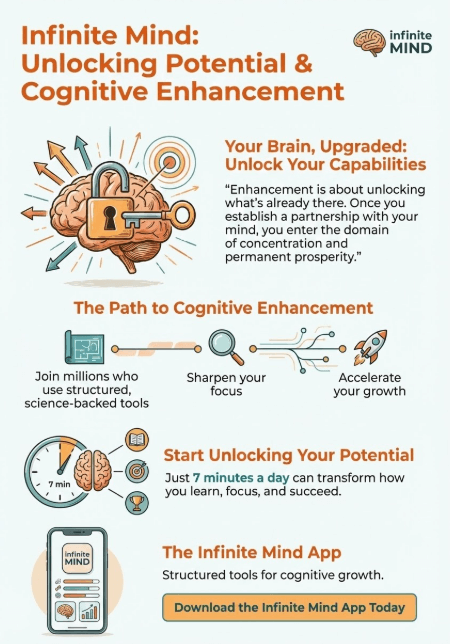
- Enhancement is about unlocking what’s already there. You are not an imitation, but rather a person who knows how to get the best of their brain with the help of modern science. Once you establish a partnership with your mind instead of a battle, you will be able to enter the domain of concentration, self-assurance, and permanent prosperity.
You’re capable of so much more. Start unlocking your learning potential today—get the Infinite Mind app and see what happens when you sharpen your focus and accelerate your growth.
Understanding Cognitive Enhancement: A Scientific Overview
Cognitive enhancement isn’t about quick fixes or trying to become someone you’re not—it’s about understanding how the brain naturally grows and using that knowledge to your advantage. At its core is cognitive flexibility, the skill that allows you to shift between tasks, adapt to new information, and approach challenges with ease. When you move from solving a math problem to writing a creative paragraph without losing momentum, you’re experiencing this flexibility in action.
What makes this possible is neuroplasticity, its lifelong ability to form new pathways and strengthen existing ones. Every time you learn a skill, practice a strategy, or challenge yourself in a new way, it changes structurally and functionally.
The Role of Nutrition in Boosting Brain Function
Your entire brain performance is based on constant and proper nutrition. Antioxidants and omega-3-rich foods such as blueberries, green leafy vegetables, fish, and nuts not only enhance memory, concentration, and overall health but also support cell communication through their vitamins and minerals, which are mainly obtained from a diet full of fruits and vegetables.
For some people, supplements can help fill nutritional gaps, but the foundation is always a balanced, diverse diet that keeps your mind energized and resilient. When your body feels supported, your cognitive performance often follows.
Harnessing the Power of Mindfulness and Neurofeedback
Mindfulness and meditation continue to show meaningful benefits for focus, emotional regulation, and mental clarity. These practices gently retrain your attention, helping you stay present even in demanding situations.
Researchers are also exploring emerging tools like neurofeedback, which allows individuals to observe their mind activity in real time and learn how to guide it toward healthier patterns. By recognizing and adjusting brainwave activity, people often experience improved concentration, steadier mood, and greater self-awareness. Brainwave modulation and technologies are being studied for their potential to support cognitive performance and mental well-being, especially for those navigating stress, anxiety, or mood-related challenges. While these approaches are still evolving, early research points to promising avenues for long-term cognitive support.
Techniques for Enhanced Mental Performance
Engaging your brain through purposeful challenge is one of the simplest—and most effective—ways to sharpen cognitive skills. Activities like memory games, puzzles, and problem-solving tasks strengthen the neural networks responsible for recall, reasoning, and sustained attention. Even certain types of video games have been shown to support faster decision-making and improved hand-eye coordination when used intentionally.
Exploring Cutting-Edge Neuroscientific Research and Innovations
The field of cognitive enhancement continues to advance rapidly as researchers uncover new ways to support the brain’s natural abilities. Innovations such as neurofeedback and other neuromodulation tools are being studied for their potential to help individuals regulate attention, improve emotional balance, and enhance overall cognitive performance.
It is promising to see how brain science will play out as these technologies are still in the making: the better we comprehend how the brain works, the more proficiently we can create the devices that will be your learning, adapting, and succeeding aids, giving you confidence.
“After guiding thousands of learners and watching their progress unfold in real time, we’ve seen a clear and inspiring pattern: the brain grows strongest when science-backed habits are paired with steady, intentional training. Neuroplasticity isn’t an abstract idea—it’s something we witness every day as people discover just how capable their minds truly are.”
Imagine finally reading those books on your shelf, mastering new skills, and feeling confident in every conversation. It starts with better focus. Download Infinite Mind and take the first step today.
Essential Resources for Smarter, More Confident Cognitive Enhancement
Scientific overview: a clear foundation for understanding what actually works
This in-depth research review helps you cut through the noise by explaining, in plain language, what science currently knows about cognitive enhancement tools and techniques. It’s a great place to start if you want a balanced, research-backed understanding before exploring specific strategies.
Resource: https://www.sciencedirect.com/science/article/pii/S1571064525000818
Neuroethics perspective: guidance for making thoughtful, responsible decisions
Here, leading researchers explore the ethical questions surrounding cognitive enhancement—questions about fairness, safety, long-term wellbeing, and personal choice. It’s especially helpful if you want to make decisions that honor both your goals and your values.
Resource: https://psychiatryonline.org/doi/pdf/10.1176/appi.focus.130308
Clinical principles: how medical experts assess new cognitive tools
The American Academy of Neurology outlines the standards doctors use when evaluating emerging or off-label cognitive enhancers. It gives you a reassuring framework rooted in professional care, helping you understand how experts weigh evidence, risk, and potential benefit.
Resource: https://www.neurology.org/doi/pdf/10.1212/WNL.0000000000213850
Supplement clarity: trustworthy research on ingredients you may be considering
The NIH’s supplement library lets you look up any ingredient—like ginkgo, omega-3s, or herbal blends—to see what the science actually says about its effects on memory, focus, or mental energy. It’s a reliable way to navigate a space that often feels overwhelming.
Resource: https://ods.od.nih.gov/factsheets/list-all/
Nootropics explained: simple, friendly guidance without the jargon
This approachable resource breaks down how popular nootropics work, what benefits they may offer, and what safety considerations to keep in mind. It’s written in a way that helps you feel informed rather than intimidated.
Resource: https://www.news-medical.net/health/What-Are-Nootropics-Mechanisms-Efficacy-and-Safety-of-Cognitive-Enhancers.aspx
Sleep as a cognitive booster: strengthening your mind through rest
The CDC’s sleep guidance shows how better sleep directly supports sharper focus, stronger memory, and greater emotional resilience. It’s a reminder that some of your most powerful cognitive tools are already within your control—simple habits that help your brain perform at its best.
Resource: https://www.cdc.gov/sleep/about/index.html
Movement and mental strength: how physical activity supports lifelong learning
This resource explains why regular movement is one of the most proven ways to support brain health. It connects physical activity to improved memory, problem-solving, and long-term cognitive vitality, reinforcing that enhancing your mind doesn’t always require complex systems or supplements.
Resource: https://www.cdc.gov/physical-activity/features/boost-brain-health.html
Supporting Statistics: What the Research Shows
- One of the most encouraging parts of this work is seeing how closely real-world progress mirrors what researchers observe in long-term studies. The science consistently confirms what we witness in practice: when people engage in structured, intentional training, the brain responds.
The ACTIVE trial, funded by the National Institute on Aging and involving more than 2,800 adults, demonstrated meaningful gains after only ten sessions of targeted cognitive practice. Participants improved in processing speed, reasoning, and even memory—areas many people assume decline steadily with age. What’s even more hopeful is that these improvements lasted for up to two years. In our experience working with learners of all ages, we see the same pattern: focused training builds stronger skills exactly where people need them most.
Source: pmc.ncbi.nlm.nih.gov
- Research also shows that physical activity can support structural changes in the brain. The hippocampus—a region central to learning and memory—naturally shrinks over time, typically by 2–3% per decade and about 1% per year after age 70. Yet in a 12-month intervention, adults who completed aerobic training increased the volume of their left hippocampus by more than four percent, while those who completed coordination training increased volume on the right side by nearly the same amount. Many individuals tell us they feel mentally clearer long before any measurable growth shows up, and findings like this help explain why the benefits often begin with how you feel before they show up on brain scans.
Source: pmc.ncbi.nlm.nih.gov - Sleep plays a powerful role as well. An NHLBI study that followed more than 500 adults for eleven years found that disrupted sleep in midlife—especially frequent nighttime awakenings—predicted poorer memory and recall later on. We often see how even small improvements in sleep quality translate into noticeable gains in focus and cognitive stability. It’s another reminder that your daily habits continually shape how your brain performs, both now and in the years ahead.
Source: nhlbi.nih.gov

Final Thoughts
Mental enhancement becomes far less mysterious once you understand how the brain actually grows. After years of hands-on research and real-time user observation at InfiniteMind.io, we’ve seen the same encouraging truth over and over again: your brain is capable of improving more quickly—and more powerfully—than most people ever imagine. The real key is consistency. When you pair the right techniques with steady, intentional practice, meaningful change follows.
What We’ve Seen Firsthand
Some of the most impressive gains come from habits that are simple enough to maintain every day. When people support their brains with balanced nutrition, mindful attention, and structured mental training, they tend to experience noticeable improvements in focus, memory, and overall mental resilience. Neuroplasticity—the brain’s ability to reorganize and strengthen itself—drives these changes, and it’s available to everyone, no matter their age or background. We’ve watched learners step into new confidence simply by giving their minds the chance to grow.
What Truly Makes a Difference
Real-world performance data uncover some significant contributors nonetheless. When a brain gets enough nourishment, it has the stable neurotransmitters needed for a long thinking process that is clear, and rich. Mindfulness helps shut off the inner mental noises and enables more profound concentration. Tailored mental training enhances the neural pathways that are relied on for memory and problem-solving. Moreover, tech tools like neurofeedback are facilitating the uncovering and leveraging of the brain’s hidden patterns and thus making one more skilled in mind management.
FAQ: Understanding Cognitive Enhancement
Q: What is cognitive enhancement?
A: Mental enhancement refers to any intentional practice that supports clearer thinking, stronger focus, better memory, or more efficient learning. The most effective approaches combine daily habits, purposeful mental training, and, when appropriate, nutritional support or medical guidance. It’s about helping your brain function at its highest level—not forcing it to become something it isn’t.
Q: Is mental enhancement safe?
A: Most natural approaches—like sleep, movement, and nutrition—are generally considered safe and beneficial. Supplements vary widely in quality, so choosing evidence-based options matters. Prescription interventions can help in specific situations but always require professional oversight to ensure safety and effectiveness.
Q: What natural methods work best?
A: Steady aerobic exercise, restorative sleep, nutrient-rich meals, mindful practices, and regular mental challenges all support brain health. These habits form a strong foundation for anyone looking to think more clearly and stay mentally sharp.
Q: Do nootropics actually help?
A: Some well-studied compounds, such as caffeine, L-theanine, and creatine, have demonstrated benefits for focus or mental stamina. Herbal options can be helpful for certain individuals, though results vary. Prescription “smart drugs” may offer improvements for specific medical conditions, but must be used under medical supervision.
Q: Who benefits most from cognitive enhancement?
A: Students looking to learn more efficiently, professionals managing complex workloads, creatives seeking sustained inspiration, and adults hoping to maintain mental vitality all benefit from a thoughtful approach to brain health. Individuals facing attention or memory challenges may find additional support through clinical guidance.